THE REWARDS OF WRITING

GOLD STARWhen I first started seriously pursuing my writing goals some three years ago, my life changed in ways that at the time I could have never imagined. Over the years, relationships formed with some very amazing people, who I never would have had the honor of knowing otherwise. My writing skills have improved and I’m more confident in my voice. In general, my friends and family have supported my journey as a writer, for which I am immensely grateful. However, pursuing a career as a writer has not been without its detractors and malcontents.

From early on, what I’d read about being a writer and the pitfalls which came from it was discouraging to say the least. Many of the articles stated that writing was a solitary endeavor which caused introversion, apathy, madness, depression and eventually led to death. Many famous examples of this gave it a modicum of truth, that was unless you became published and garnered a healthy following, then you just ended up dying of a heart attack due to lack of exercise and/or poor diet. I also read that there was little to no money or reward in writing. A more highly compensated career path such as law or medicine was encouraged.

Unfortunately, there is merit to what I read and there are undeniable truths in much of it. I think that writing can lead to the above maladies—which can prove fatal—but, I know that those very same afflictions can arise from a multitude of other professions, some of which practically guarantee far more compensation and personal accolades. It’s also true that because writers are usually sedentary, most of us aren’t the most fit or health conscious people in the world. As far as making truckloads of money from writing, less than 1% makes more than four figures a year. Even ER doctors and small time dentists can do better monetarily. However, one thing—from the above mentioned pitfalls of writing—that I feel has absolutely no merit or truth, is that there is little to no reward from writing.

I have found that writing is rewarding on so many different levels that it is in itself invaluable. I cannot begin to tell you how many times that writing a blog post or a journal entry has saved the last remnant of my threadbare sanity. As an outlet for an emotional meltdown, the latest family crisis, or dealing with all of the voices of your characters in your head, I’ve found writing to be very therapeutic. Writing is also something which is a huge part of who I am as a person, which is rewarding in its own right. Having a high paying career and being unhappy would only go so far. Money can buy you a lot of things, however it can’t buy you fulfillment.

Writing can also serve as an obvious means of expressing one’s thoughts and ideas, in such a way as to inform, entertain, make a statement or create change. Yet, telling stories can also be a very selfish effort as well. I’ve found that my motivation for writing isn’t always altruistic.

If there’s a book you really want to read, but it hasn’t been written yet, then you must write it.

~Toni Morrison

I have come to live by the above quote from Morrison, as it sums up the previous statement perfectly.

In all of the other examples of rewards one can gain from writing, I feel that this final one is most important. Not solely because it can serve to prevent the previously mentioned pitfalls of writing from becoming fatal, or because it can inspire and empower us to reach our fullest potential, not only as writer’s, but also as humans. I feel that this final example is most important because it has the power of giving us hope. Hope of learning from our past, hope of coping with our present and hope of brighter futures, just beyond the horizon. I’m talking about family.

I have been blessed to have entered into a very eclectic, multi-cultural, multi-ethnic family of writers dedicated to the craft and each other. I feel that the personal relationships that I have and continue to develop with fellow writers are crucial to my ability to persevere in the darkest of times we writers face. My college professor, Jim Powell once told me that without the human condition/connection, our writing would be without meaning, no matter the genre. That not only applies to the content of our work but how we live as a community. I believe in the truth of his statement and what it means for the millions of writers out there grinding out their work every day just as I do.

I have experienced the awesome comradery which being a part of a community of writers provides. How we share, how we laugh, how we cry, and I know that we are a very special group of people. I have had the honor of meeting and befriending a great group of writers who have helped to guide me, inspire me, and support me as a writer and as a person. I can only hope to repay their kindness with kindness of my own and an extended hand to others I meet along my journey. We as writers, have an obligation to continue moving the art of writing forward by remaining vigilant in our efforts to strengthen our collective community. We must take every opportunity to extend a hand to our brethren, helping them along on their journey as best we can. Although it’s impossible for us to know each and every one of our brothers and sisters on a personable level, I believe we are of a shared consciousness and linked by our call to write. We must always remember that when we reward each other, we reward ourselves, and the rewards are invaluable.

REMEMBER TBIYTC!!!

THE ROAD MORE OR LESS TRAVELED…ALONE

Creating the elusive perfect story is a solitary endeavor, but it doesn’t have to be a lonely journey.


Lonely manThe art of writing or the mere pursuit of it is an infinite journey of self-discovery. Writers draw from their various life experiences to tell stories which speak of who they are and where they’re from. Because of the amount of introspection necessary to formulate a story, writers are often portrayed as eccentric loners, whose brilliance is inextricably intertwined in their quirkiness. The image of the withdrawn, lonely, psychotic and often self-destructive figure, banging away at the keyboard has become an accepted icon for the writer’s life.

As a writer, I’m here to tell you that the aforementioned assessment of writers is not entirely accurate and yet not entirely without merit either. When the writer is trying to extricate the ideas that form the story they want to tell, it is an internal process which only they alone can achieve. It is often painful and lonely. Writers place themselves in an environment that is isolated, so as to afford optimal concentration and peaceful reflection. However, along the way we must take the opportunity to interact and network with others, or else doom ourselves to failure. Writers are natural born observers of the world around them. They interpret the various events they see—in the chaos we call life—that touches them and compels them to create a story only they can tell. Yet, for all of the observations, mental snapshots and quickly jotted notes on the happenings around us, we must also interact with the world we’re drawn to observe.

I’ve found that a cup of coffee with another writer, or group of writers helps to quell the feelings of isolation writers are often subject to. It gives us not only the opportunity to express ourselves to others and get constructive feedback, but also to take a break from the act. Writers know that deadlines, whether from an agent, publisher or self-imposed are the gremlins of psychotic breakdown. They are necessary evils that we cannot escape yet, we can’t let them drive us insane either.

Reliable sounding boards, a referral to a service for assistance in an unfamiliar business aspect of the writing business, are few of the benefits to networking and interaction. We must also not forget that maintaining a healthy dialogue with others can improve our writing when we’re faced with creating a scene where dialogue is required. It can also help with character development as well. Despite my call to occasionally step away from the writing machine, I am aware that it is unrealistic to expect a total abandonment of a writer’s nature to observe.

Writers are some of the most creative people ever produced, and as such are prone to anxiety and depression. In order to combat this we must force ourselves to take the time to stop, breathe, and interact with others, not only for the purpose of improving our writing itself, but also to save ourselves from the fate of the iconic stereotype. As a community we must work together to keep ourselves from falling into the abyss of isolation and depravity. We should live by the motto, “United we stand, divided we fall,” and help ourselves to realize that, “The road more or less traveled, doesn’t have to be traveled alone.”

HOW TO CREATE A WRITER’S PLATFORM AND WHY?

Clip Art Graphic of a Brown Guy CharacterAs writers, we’re inclined to devote much of our time in the pursuit of our main objective and that’s to write. Most writers make lousy business people, unless their background is in a business related field.

We are imaginative people who have a passion to create, so we tend to be oblivious to the business of writing. However, one of the first things that writers need to understand is that they can write eight million stories, but if no one knows about them they won’t get published and no one will read them.

There are many reasons that it is necessary for writers to create a platform. The most basic reason is to inform the public—your potential audience—about your writing. However, the concept of a platform is a bit deeper than merely letting people know you’re a writer, it’s also your ability to personally sell books through:

  • Your own individual merit
  • Networking—personal and professional connections
  • Media outlets which can be utilized to sell your books

How well people know you and know of you, is extremely important as it relates to establishing a platform.

Well before I signed the contract for my first novel and short stories, I began using as many resources as I could think of to let people know that I was a writer and I had work to sell!

I instinctively got out in front of creating a platform for myself and my writing. Mostly I was simply geeked about the idea of people reading my work. Now, I am developing, maintaining and utilizing my platform for more focused reasons.

For the purposes of this blog post, I will assume that most of my readers are new writers or those who are just now accepting their calling. Although anyone, at any stage in their writing career needs to create a solid platform—if they haven’t already—and could benefit from the information contained here.

The following is a list of the most basic and common building blocks necessary for creating a platform.

  • A website and/or blog—the goal is to build and maintain a large and loyal readership
  • Social media—this is one of the most important aspects of building a platform as it allows for the most immediate and wide-reaching exposure you’re likely to get
  • Blog posts—this is how you are able to relate your writer’s journey to your readers and help them to learn from your experience(s)
  • An e-newsletter and/or mailing list—this helps you to maintain your readership and keep them informed of important info pertaining to your writing
  • Guest post on the blogs of other writers—this is a way for you to broaden your readership and outreach
  • Memberships in writing organizations—this helps to establish your standing and credibility within the writing community
  • Media exposure—writing articles for media outlets, public speaking and media appearances (here the BIGGER the better)

While not all of these components are going to be relevant to you and/or necessary, they are the most important to consider. In today’s market and society, a website/blog, mailing list and social media are the three most important building blocks to consider in my opinion. These three components are the ones which will account for the maximum amount of exposure you get and the farthest reaching attention you receive.

It’s important to understand that building a platform takes time and effort.

This doesn’t happen overnight!

Developing a following/readership takes perseverance and dedication. It is a continuing effort which happens daily.

The amount of effort and foresight you put into it, is directly indicative of the gains you get out of it. Simply creating a website/blog and being on Facebook or twitter doesn’t constitute having a platform.

Here are some helpful anecdotes for defining just what platforms are:

“I have a simple formula for platform: Authority + Network = Platform.”

~Roseanne Wells (Marianne Strong Literary Agency)

“A platform is the people who know and love you and your writing now, as opposed to all those hypothetical people that will know you once your book is bought and you get motivated to do all the social media stuff…built-in audience.”

~Meredith Barnes (formerly of Lowenstein Associates, Inc.)

“A platform showcases the experiences you’ve had that qualify you as an expert in your field, which advocate your successes and serve as a vehicle for your publicity.”

~Bernadette Baker-Baughman (Victoria Sanders & Associates)

Simply writing your novel or short story isn’t enough. Even getting it to the publisher or self-publishing isn’t enough. You have to establish an identity/brand, own your marketability and work diligently to cultivate your readership with every opportunity available.

In closing, I’d like to encourage any writer—new or established—to consider taking the time and making the effort to build and maintain a solid platform. It is a highly essential component of selling your books/stories and connecting with loyal and well entertained readers.

WRITERS WORKSHOP OF SCIENCE FICTION & FANTASY

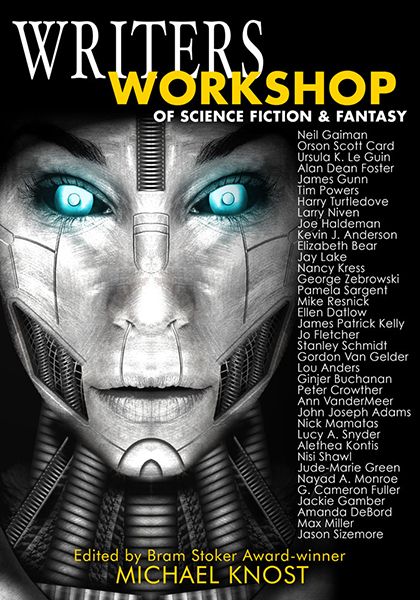
My publisher, Seventh Star Press is proud to announce that Writers Workshop of Science Fiction & Fantasy,  an incredible book by editor Michael Knost, is now available in eBook format, with print availability in trade paperback due on Wednesday. This release features contributions from a sensational list of writers such as Neil Gaiman, Orson Scott Card, Kevin J. Anderson, Ursula K. Le Guin, Harry Turtledove, Joe Haldeman, and many other top names in genre fiction, Writers Workshop of Science Fiction & Fantasy is a highly valuable contribution to the speculative fiction community developed by Bram Stoker Award-winning editor Michael Knost.

Final-WW_cover-WebWriters Workshop of Science Fiction & Fantasy is a collection of essays and interviews by and with many of the movers-and-shakers in the industry. Each contributor covers the specific element of craft he or she excels in. Expect to find varying perspectives and viewpoints, which is why the reader will find many find differing opinions on any particular subject. It is a book with something to offer all levels of writers, from those seeking to get published for the first time to others who have numerous releases to their credit.

This edition also features several original illustrations from award-winning artists Matthew Perry and Bonnie Wasson. In addition to their own illustrations, a special collaborative piece created by the two artists is featured in the book.

Available by mid-week in trade paperback format, Writers Workshop of Science Fiction & Fantasy is now available in eBook format for the Kindle and Nook at the following links for just $4.99

CLICK THE LINKS BELOW TO LEARN MORE & GET YOUR COPY TODAY!!!

Amazon Kindle

Amazon Kindle UK

Nook

http://seventhstarpress.blogspot.com/2013/04/writers-workshop-of-science-fiction.html

ARE YOU A WRITER?

typewriter_1_lgAre you a writer and if so, why do you write and what do you write? Are you a starry eyed reader who thinks that the writing life is an exclusive society of posh, well to-do people who revel in success? These are serious questions you must ask yourself if you dare to write. I didn’t ask myself these questions at first and my awakening was not so much rude, as it was extremely educational.

The following quote is from Fantasy writer, R.A. Salvatore:

There’s way too much pain in this business (writing) for anyone who doesn’t have to write. I always tell beginning writers, “If you can quit, then quit. If you can’t quit, you’re a writer.”

~ R.A. Salvatore

Salvatore’s advice is sage. In my experience, I’ve learned that writing will confound you, make you angry, depress you and attempt to drive you insane. However, if none of the above puts you into a psychiatric hospital then it can also be quite rewarding. Though if you’re looking for fame and fortune, then writing isn’t likely to be your ticket to it.

Writing is a discovery and a continuous learning process. If you stop learning, stop reaching for that forever elusive perfection (The Perfect Story) which writers always pursue then you’re not writing. Writing is an exploration which serves to help the author discover things about themselves which they never realized or ignored, and also serves as an expression of the author’s thoughts and emotions which both entertain and inform the reader. If you’re extremely lucky you will accomplish all of this, and do it well. If you’re like most of us, you will attempt it and maybe your readers won’t notice your mistakes.

While pursuing your goals as a writer, it’s important to learn and apply the proper mechanics which all writing instructors drill into you. Rigid rules which when followed will help you to produce fair, if not great work. However, it’s important to understand that writers often break those rules by following them and therein is the trick…the story itself.

Your story is the means by which you can break the rules successfully once you’ve mastered the rules in the first place. Confusing? Yes, it is. Now you can get a glimpse into the mania of a writer. In my humble opinion, what you write isn’t too important as long as it’s good. So if you write poetry, essays, short stories, novels or all of the above, no matter what genre make it good. I won’t list the rules which make a good story in this blog post (perhaps in a future post), because that is a lengthy list, and not the purpose of this posting.

Every writing instructor I’ve encountered on the collegiate level (for one reason or another), looks down at genre fiction from the lofty height of their literary perches. These professors often expound that the substance of anything outside of literary fiction is mostly garbage. While is some cases this may be true, the same can also be said about literary fiction.

DON’T GIVE UP YOUR DREAMS OF WRITING GENRE FICTION, IF THAT IS YOUR PASSION!

There is an audience for your work, and you can succeed. Writing instructors are paid to pontificate about the higher quality of writing that goes into literary fiction, as they expound upon the merits of avoiding genre fiction. Let the haters hate, because that’s what they do, and they’re quite good at it.

If you choose to write genre fiction (like me), make sure you plot out your stories very carefully and don’t get caught up in the nuances of the world you create. Your story must have a human element in order to reach the reader on a human level. This can be very challenging and (like myself), you will undoubtedly miss this mark at least once in your career. Not every story an author writes will resonate with every reader, even though that should be the writer’s goal.

Should the author be embarrassed?

Should they hide themselves away like a pariah?

Not if they learn from it. Some element within your writing must touch upon what we know to be true to the human condition. A former instructor of mine gave me that advice and I ignored her on a story I wrote…let’s just say the next critic was downright rude. I took what criticism had merit to heart and chocked the rest up to their disdain for commercial fiction.

If nothing and no one can dissuade you from your passion for writing, then welcome to a career of pain, suffering and blessed rewards!

Writing in and of itself is no easy endeavor, and requires quite a large chunk of your soul to achieve. So, no matter what area of writing you practice, (from business writing, poetry to essays to screenwriting to prose, short stories, novels or flash fiction) I believe that it is important, and makes a contribution to the fold, at least on some level. Quality writing isn’t exclusive to literary fiction; it can be found in all genres. And what’s most important is that readers are given what all readers want…A GOOD STORY!

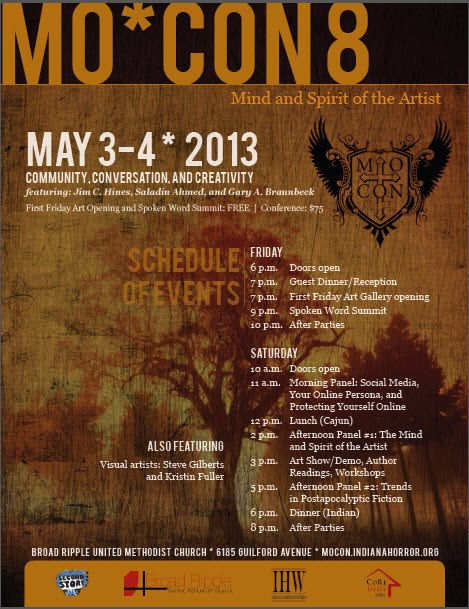
MO*CON 2013: MIND & SPIRIT OF THE ARTIST

Maurice Broaddus
Maurice Broaddus

This week I interviewed Maurice Broaddus, an urban fantasy author with dozens of published short stories to his credit and a novel trilogy titled, The Knights of Breton Court. We discussed the annual writing convention he hosts called Mo*Con and held in Indianapolis, IN.


How did Mo*Con come about?

Mo*Con came about for 3 different reasons.

First, my wife wanted to experience conventions and the thought was to create a convention that she could experience firsthand.

Secondly, at the conventions I attended I had great conversations with other writers and I wanted to replicate that experience in a room party environment as the convention itself. The conversations were relaxed and covered a wide range of topics from religion, politics, current affairs and of course writing.

Third, I wanted to do a writing convention at a church and Mo*Con was a prime opportunity to do this. At the time, I was running a local church and I basically wanted the church to be a safe place for these types of conversations.

What prompted you to name the convention Mo*Con?

A friend of mine—Chesya Burke—knew I hated nicknames. Mo, being a nickname for Maurice lead to the name Mo*Con. From there it just seemed to stick.

Who sponsors Mo*Con?

In the beginning, Mo*Con was a one man operation. I ran everything by myself until a friend suggested that I look to other sources of support to make the convention happen.

I have partnered with organizations such as: Cities of Refuge, Broad Ripple United Methodist Church, Community-supported.org and Indiana Horror Writers (IHW).

Who is the intended audience for Mo*Con?

All are welcome, but primarily those who are interested in hearing writers speak on social issues and the intricacies of their craft. Those most involved consist of horror and fantasy readers and writers. However, we want to spoil writers and celebrate their contributions, while involving the community.

How do you see Mo*Con evolving in the future?

It’s an ongoing process. We’ve had everything from a Celtic Rock concert, a puppet show and a horror writer who delivered a sermon at the church. We intend to let it evolve organically and simply see where it takes us.


MO*CON 2013
MO*CON 2013

So, if you’re in Indianapolis during Mo*Con do yourself a HUGE favor and stop by on Friday, or better yet go ahead and RSVP purchase your tickets now!The event will be held at Broad Ripple United Methodist Church in Indianapolis from May 3-5, 2013. Full registration price is $75. If you can’t make it but would like to support Mo*Con, why not become a non-attending sponsor.

For more information, visit: http://mocon.indianahorror.org/ or

https://www.facebook.com/pages/Urban-fantasy/108464595844706?fref=ts#!/events/357048291062838/?fref=ts

A WRITER’S DEPRESSION: PART TWO

Hello everyone!

I’m picking off where I left off in the two-part series dealing with Writer’s Depression.

Depressed Writer Clipart As a writer how suffers from depression, I know first-hand how devastating the effects of it can be.   The symptoms in and of themselves are enough to weigh a person down like an anchor, but how can  we fight against it? How can we win a battle raging inside of our minds?

One therapeutic strategy for depression is exercise!

Given that quite a few writers live a somewhat sedentary lifestyle (I mean we do sit down and write…a   lot!), it’s no wonder that we don’t really do much in the way of formal exercise.

I’m guilty as charged.

I find it to be a very daunting task to exercise. Mostly because of physical ailments/conditions which limit my mobility at times. However, at least two of my current conditions could be all but eliminated with moderate exercise and a proper diet.

Another part of the equation is that if you’re depressed already, any task which you find daunting in the first place can become even more so if you’re already in that dark place mentally and emotionally.

Experts recommend at least 30 minutes to an hour a day, 5-6 days a week of moderate exercise, coupled with eating a healthy diet, something which is also therapeutic for depression.

Often writers keep a daily journal and this also is a way in which to combat depression. Think of it as a way to daily exercise your inner demons and purge those thoughts and emotions which contribute to your depression in the first place.

Many of my writing peers have told me that they began writing in the first place to cope with depression. They found it to be an escape from this stresses of day to day life, which they felt were the culprits in their depressed states. But taking into account the stresses of deadlines and the task of developing a story draft that a writer feels comfortable with, can lead them back into the dark place they had sought to escape.

The most important component in dealing with depression for writers and everyone in general—in my opinion—is to first identify that depression is real and serious. Then seeking professional advice or at the very least seeking a writing group which allows you to express your feelings in an open, non-judgmental forum.

In closing, I’d like to say that I’ve employed at least two of these strategies at some point in my journey and some worked better than others for me. It’s all a matter of doing what’s best for you as an individual, but the most important thing is to DO SOMETHING!!!

A WRITER’S DEPRESSION: PART ONE

Depressed Writer Clipart  I am a writer…


 I am depressed…


  I am not alone…


Writing is very often a solitary journey into the inner depths of one’s soul. A lot of what writers do is re-experiencing moments from our lives and/or our environments. We recreate and reimagine events in prose form, all in the effort to educate, entertain or uplift—sometimes all three.

Hours of our time is spent with a notepad, tablet or computer using words to interpret the miasma of thoughts and ideas swirling within our minds and souls, with very little—if any—regard to the effect that might have on our well-being.

A saner person might ask, “Why do you subject yourself to such torture?” The answer, isn’t always understandable to those who aren’t writers, but is as clear as clean air to most writers.

We do it because; we can’t stop…

Acclaimed fantasy writer, R.A. Salvatore is quoted as saying: “…if you can quit, then quit. If you can’t quit, then you’re a writer.”

As writers, we are drawn to this form of self-expression because it is within us to create and explore—both our own minds and the world around us. However, sometimes our called profession can cause us to spiral into a dark, lonely and sometimes dangerous place.

If it weren’t bad enough that writers face the sometimes daunting—but often rewarding—task of creating prose from the myriad reaches of our psyches, and attempt to make a living from our craft, we also are at war with our very own minds. We struggle to produce earnest prose, but are hardly ever satisfied with ourselves or our work. The phrase, “You are your worst critic,” is cliché yet, very succinct in its accuracy in describing why writers carry the burden of self-doubt, which is the leading contributor to depression amongst us, in my opinion. It is our own ambivalence which often proves to be our very undoing.

According to Portland based author and psychotherapist, Philip Kenney, At its best, self-criticism seems to drive individuals to revise and polish work. At its worst, it can torment and paralyze one’s efforts and completely distort the self-portrait beyond recognition.”

Writers and other creatives are sensitive people, perhaps more sensitive than many other individuals in other fields. Most of us are very critical of ourselves and our work, which is what drives us to improve in our craft, but can also be the debilitating bane of our existence.

It is our sensitivity which gives us the insight into our minds and the world around us and allows us to create the worlds and characters in our work. It gives us the ability to explore our fears and emotions in a way few others can experience.

However, there is a price…

That same sensitivity makes us very vulnerable. As we delve into the unconscious and subconscious of our minds, we are forced to confront those dark places hidden away from the rest of the world. Places which are very often too painful to talk about verbally, we use our writing to communicate about.

That’s pretty scary stuff, indeed.

Writers are prone to being overstimulated and suffer from emotional overflow. This often leads to anxiety—which in my experience—can cause an assortment of problems in the writer’s ability to function on the day to day and interact with others—most importantly their family.

We also tend to internalize our feelings and thoughts. Expression in writing is not synonymous with verbal communication, and we are frequently faced with anxious, emotional overload, which can cause us to have morose and solitary periods, as well as traumatic breakdowns.

In my next blog post, A Writer’s Depression: Part Two, I will explore the ways in which writers can deal with their feelings of anxiety and how to possibly determine the difference between the nagging self-critic and perhaps a deeper problem.

MY FIRST WRITER’S RETREAT EXPERIENCE

IHW LOGO7aOn Friday, February 22, 2013 I attended my very first Indiana Horror Writers (IHW) Writer’s Retreat and the experience was very rewarding. I went into this with feelings of excitement and wariness. I’d heard stories from my fellow writers on what to expect and prepared myself accordingly. The first evening was spent settling into our rented townhome for the evening and unwinding from our outside lives.

When writers gather together it’s inevitable that we talk shop. Many of the struggles we face as writers are best understood and most sympathized with by other writers. But, there was plenty of time devoted to socializing and partaking in adult libations.

Our time together was semi-structured and not just a frat party weekend for writers, although we had our Animal House moments of lounging around drinking, listening to 80’s music and talking about such diverse subjects as our favorite pop culture icons to the role of S&M in writing.

On Saturday we all trickled out of bed and made our way to the kitchen for coffee—one of two brown liquids often associated with writers. We ate breakfast and then when everyone was at least semi-coherent, some of us participated in a writing exercise. The idea was to take a prompt and free write for fifteen minutes a piece of flash fiction, which we would then read to the group.

I was amazed at the level of creativity attained by some of my fellow writers. Their pieces—with minimal polish—sounded as though they were ready for publication. Although they all had speculative fiction slants, they were generally the funny type of stories you could find in Reader’s Digest or the Saturday Evening Post.

We won’t talk about mine…apparently the coffee hadn’t kicked in yet.

Later that afternoon after a couple hours of idle conversation, we grabbed our laptops and headed to the great room for a workshop. The leader gave us certain broad parameters to follow in stages which focused on developing a viable plot for a short story and/or novel. At the end, we shared what we’d come up with and again the level of creativity was astounding.

Apparently by then the coffee had done its thing because my peers enjoyed what I’d written and it was something I could feel proud of creating, unlike that prior writing exercise which shall never see the light of day.

We then dispersed to grab showers and then make our way to Irvington for a debut book signing featuring members of our group. The bookstore was quaint and cozy. There were a number of people who showed up to meet, greet and get signed copies of our friend’s newest tome.

The authors and editors of Dark Faith: Invocations @ Bookmama's in Irvington, day 2 of the IHW Retreat. Lucy Snyder, Gary Braunbeck, RJ Sullivan, Maurice Broaddus, Kyle Johnson & Jerry Gordon.
The authors and editors of Dark Faith: Invocations @ Bookmama’s in Irvington, day 2 of the IHW Retreat.
Lucy Snyder, Gary Braunbeck, RJ Sullivan, Maurice Broaddus, Kyle Johnson & Jerry Gordon.
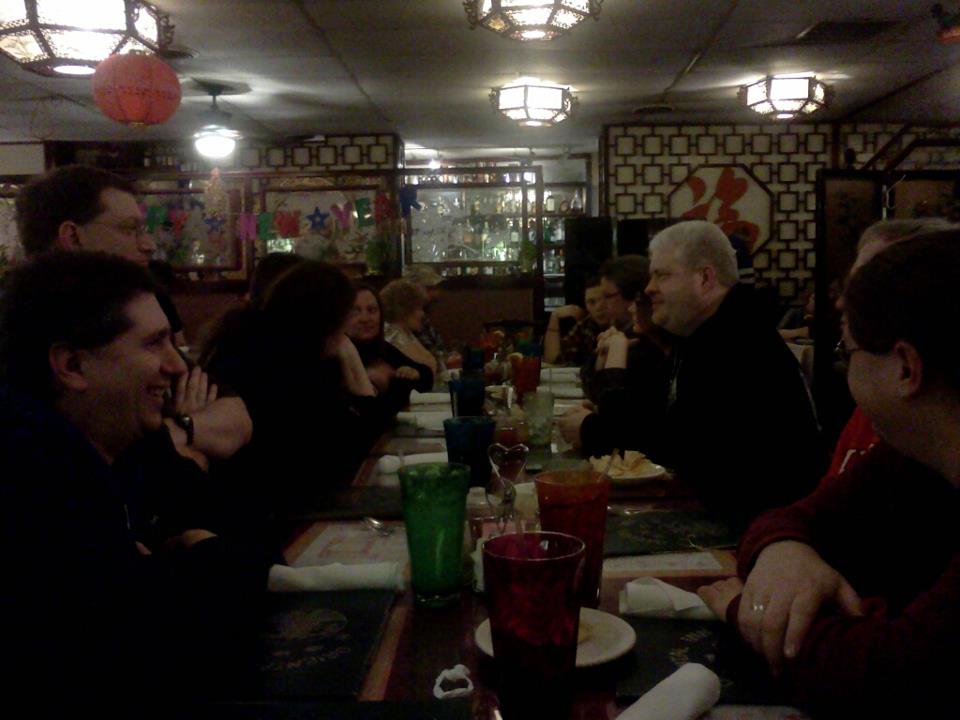
The IHW Gang @ The Oriental Inn, day 2 of the IHW Retreat! — with Rj Sullivan, R.J. Sullivan, author, Drew Leiter, Todd Manning, Kathy Watness, Natalie Phillips, Gerald Carlstrom, Rodney Carlstrom, Gary A. Braunbeck, Lucy Snyder, Michael West, Bill Larson and Chris Garrison.

Riding the high of a successful book signing, we headed out to a neighborhood Chinese Restaurant for an evening meal. It was the first time I’d been to this particular establishment and I must say that on the outside it looked like a hole in the wall joint. However, the food and service was excellent and their menu prices were very reasonable.After everyone had gotten their food fix and were dealing with a case of the “I-tis”—after eating lethargy—we made our way back to our rented townhome to settle in for the evening.

A group of us again gathered into the great room and pulled out our laptops to pull up a piece of our work to share in a group reading. The stories shared were fantastically well written and crafted. The sneak peeks of, “Works in progress” from my peers was entertaining, enlightening and proved that I had joined a group of truly talented people.

Some of us, in an attempt to relive our youths stayed up until the wee hours of the morning; snacking, drinking and talking about nothing in particular. It was our last night and we wanted to be rebels, which we paid for the very next day.

As we tumbled out of bed like newly awakened day walkers, rising from a deep hibernation, we made our way to the kitchen for that morning elixir we writers seem to thrive on.

Me, Michael West Chris Chris Garrison & Rj Sullivan @ The IHW Retreat, Final Day! TCQ
Me, Michael West, Eric Garrison & Rj Sullivan @ The IHW Retreat, Final Day! TCQ

The end of our weekend retreat culminated in a brunch buffet where we talked about our assessment of experiences that weekend. Our out of town guests returned safely to their bailiwicks and we left in anticipation of next year’s retreat and what new and wonderful excitement it would hold.

This blog post is an illustration of how new experiences can and do strengthen our creativity and help to build important and lasting relationships for the future. If you are a writer and have the opportunity to attend a writer’s retreat, I highly recommend that you go.

You will be changed.